
Cool Down This Summer: Your Complete Pitta Dosha Summer Routine

Published: 27 May 2026 | By Suvarn Naturals Team
TL;DR — Key Takeaways
TL;DR — What You’ll Learn
🌿 Explore Suvarn Naturals cooling herb powders →
Summer is Pitta season — your skin, mood, and hormones feel the heat first
A Pitta dosha summer routine combines cooling herbs, specific meal timing, and skincare rituals
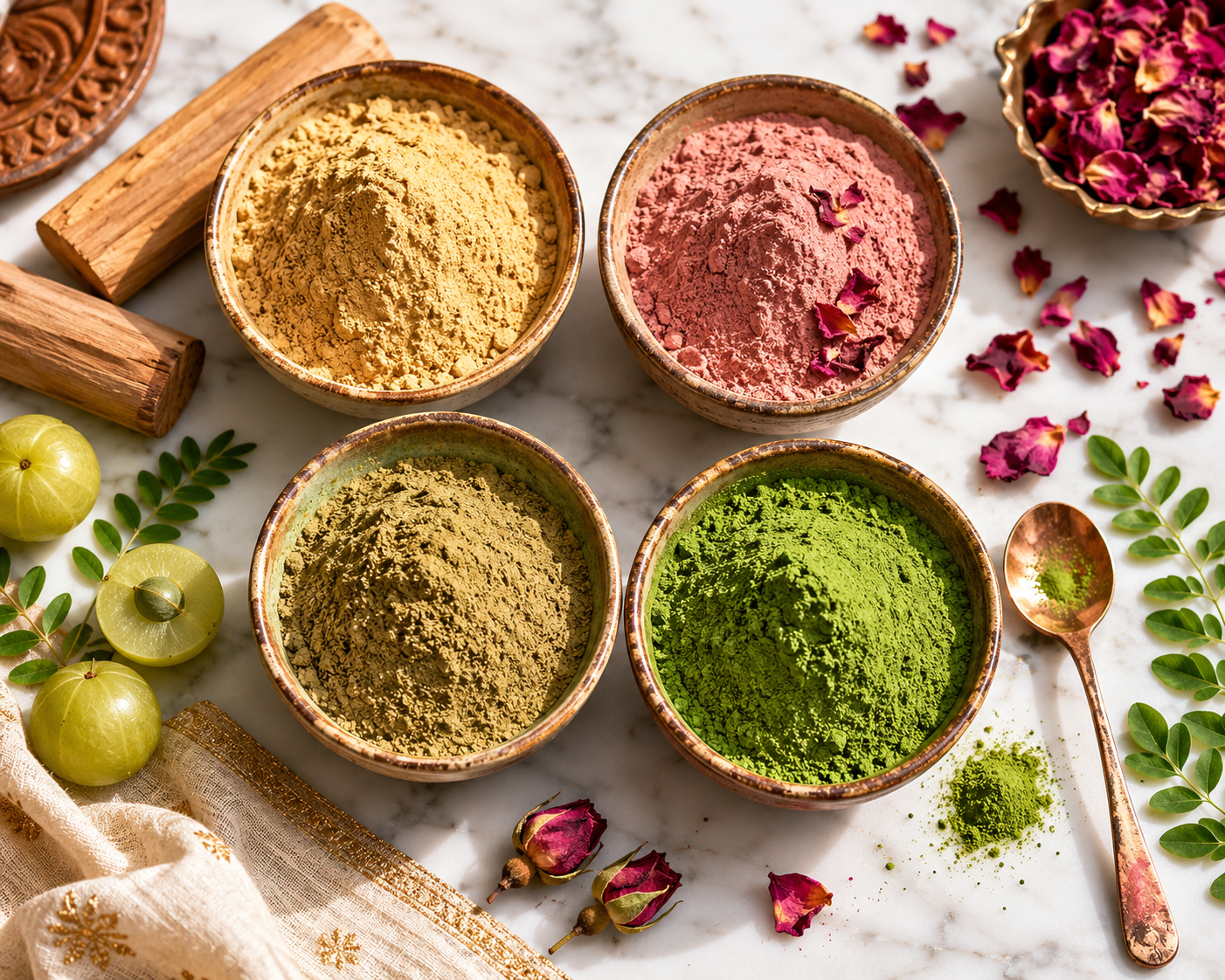
Sandalwood, Rose, Amla, and Moringa are the four powerhouse Ayurvedic herbs for summer Pitta balance
Your skin type, PCOS symptoms, and stress levels all point to the same root cause: excess Pitta
A 3-minute daily ritual using cooling botanicals may support calmer skin and steadier hormones
Does summer feel like it attacks you from the inside out? Breakouts appear overnight. Irritability spikes before 10 AM. Your scalp burns, your gut rebels, and sleep becomes elusive — even in an AC room. If this sounds familiar, you may be experiencing Pitta aggravation.
Published 27 May 2026, this guide walks you through a complete Pitta dosha summer routine — one that goes beyond the usual “drink more water” advice. You’ll find Ayurvedic wisdom grounded in current research, a founder’s perspective on sourcing cooling herbs, and practical rituals you can start tonight. No complicated protocols. No expensive supplements.
What Is a Pitta Dosha Summer Routine?
A Pitta dosha summer routine is a seasonal lifestyle protocol from Ayurveda designed to pacify the fire-dominant Pitta energy that naturally escalates during India’s summer months (March–July). It combines diet, skin rituals, sleep timing, and cooling botanicals to restore balance before symptoms like skin inflammation, acid reflux, hair fall, or hormonal disruption appear.
In Ayurveda, Pitta (पित्त) is the dosha composed of fire (Agni) and water (Jal). It governs transformation — metabolism, digestion, hormonal conversion, and skin cell turnover. The Sanskrit term Pitta comes from the root tap, meaning “to heat.” When ambient heat rises in summer, it mirrors and amplifies the Pitta energy already within your body.
Key Pitta constituents and their roles:
- Pachaka Pitta — governs digestion and enzymatic action in the gut
- Ranjaka Pitta — responsible for blood formation and liver function; linked to hormonal health
- Bhrajaka Pitta — resides in the skin; controls complexion, heat dissipation, and skin immunity
- Sadhaka Pitta — the emotional dimension; when aggravated, it drives irritability, perfectionism, and burnout
Modern science maps neatly onto this: Pitta aggravation broadly corresponds to elevated inflammatory cytokines, cortisol dysregulation, and impaired skin barrier function — all of which worsen in sustained heat exposure.
The Science + Ayurvedic Perspective
Ayurveda operates on the principle Samanya Vishesha Siddhanta — “like increases like, opposites create balance.” Summer’s heat (Ushna), sharpness (Tikshna), and intensity (Teekshna) mirror Pitta’s own qualities. The body needs cooling (Sheeta), sweet (Madhura), and heavy (Guru) inputs to restore equilibrium.
Modern research echoes this logic. Heat stress triggers the HPA (hypothalamic-pituitary-adrenal) axis, elevating cortisol. Sustained cortisol elevations are linked to acne flares, hormonal imbalance, disrupted menstrual cycles, and increased Pitta-like inflammation markers. Cooling adaptogens and anti-inflammatory botanicals may help moderate this cascade.
A 2024 case report published in Cureus (Jadhav et al., PMC10945471) noted that Pitta dosha imbalance was clinically correlated with inflammation, hormonal irregularities, and excessive body heat in women with PCOS — directly validating the Ayurvedic framework using Western diagnostic criteria.
Myth vs. Fact: What Most Blogs Get Wrong About Pitta Dosha
| Common Myth | Ayurvedic Reality | Modern Support |
|---|---|---|
| “Only Pitta body types need a summer routine” | All three doshas are affected in summer; Pitta simply aggravates first and fastest in everyone | Seasonal cortisol fluctuations are universal, not constitution-dependent |
| “Eating cold food is enough to cool Pitta” | Cold food can actually dampen Agni (digestive fire), worsening digestion — Sheeta Virya (cooling potency) of herbs matters more than temperature | Thermic effect of food research supports that food temperature ≠ food potency |
| “Pitta only affects digestion in summer” | Bhrajaka Pitta (skin) and Ranjaka Pitta (hormones/liver) are equally impacted — skin breakouts and menstrual irregularities are often the first visible signs | Dermatological studies confirm heat-triggered acne and inflammation pathways in summer months |
The myth this guide challenges: Nearly every competitor blog suggests that a Pitta dosha summer routine is just about eating cucumbers and avoiding spice. This dramatically undersells what summer does to women’s hormonal and skin health — and ignores that topical cooling rituals (the skin being the body’s largest thermal organ) are equally essential.
Benefits of a Pitta Dosha Summer Routine — Especially for Women
1. Calmer, Clearer Skin
Bhrajaka Pitta, which governs the skin, becomes hyperactive in summer. Excess heat translates to increased sebum, larger pores, inflammation, and acne — especially around the jawline and cheeks (a hormonal Pitta pattern). A consistent cooling routine may support reduced skin inflammation and improved skin barrier function.
Sandalwood (Chandan, Santalum album) is the classic Ayurvedic herb for this. Its key bioactives — α-santalol and β-santalol — are documented to have anti-inflammatory and antimicrobial activity, supporting skin health from the outside in.
💡 Quick tip: Mix Suvarn Naturals Sandalwood Powder with cold rose water and apply as a 10-minute face mask three times a week during June–August.
2. Hormonal Steadiness (Especially in PCOS)
Ranjaka Pitta governs the liver and blood — and by extension, hormone metabolism. Excess Pitta in summer may dysregulate estrogen and androgen processing, worsening PCOS symptoms like irregular periods, acne, and mood swings.
A 2024 study in Cureus specifically linked Pitta imbalance to hormonal irregularities and inflammation in PCOS patients. Amla (Amalaki, Emblica officinalis) is one of the few Ayurvedic herbs documented to balance all three doshas — uniquely cooling despite its sour taste, and traditionally used as a Rasayana (rejuvenative tonic) for hormonal and reproductive health.
💡 Quick tip: Add ½ tsp of Suvarn Naturals Amla Powder to cool water with a pinch of cumin every morning. Traditionally used to support liver function and hormonal balance.
3. Reduced Hair Fall and Scalp Heat
Many women notice a sharp increase in hair fall between April and July. Ayurveda attributes this to Bhrajaka Pitta spreading to the scalp (murdha), increasing scalp temperature and weakening the hair roots (Kesha Mula). Cooling the scalp directly — and internally through diet — may support hair retention.
Moringa (Shigru, Moringa oleifera) is dense in iron, zinc, and antioxidants that traditionally support Rakta Dhatu (blood/hair nourishment). Rose (Shatapatri, Rosa centifolia/damascena) soothes scalp inflammation when applied topically.
💡 Quick tip: Combine Suvarn Naturals Moringa Powder into a morning smoothie or lassi — it may support the nutritional foundation for strong hair roots.
4. Mood Regulation and Reduced Burnout
Sadhaka Pitta — the emotional dimension of this dosha — is often completely overlooked in wellness blogs. This sub-dosha governs how we process emotions, respond to stress, and maintain mental clarity. In summer, aggravated Sadhaka Pitta may manifest as perfectionism, short temper, impatience, and eventually burnout.
Rose (Rosa spp.) is Ayurveda’s primary herb for cooling Sadhaka Pitta. Its Hridya (heart-nourishing) quality calms emotional heat without sedation.
💡 Quick tip: Stir ½ tsp of Suvarn Naturals Rose Powder into warm (not hot) oat milk before bed. Traditionally used to support restful sleep and emotional balance.
5. Digestive Comfort in the Heat
Pachaka Pitta governs digestion — and paradoxically, summer can both over-stimulate and disrupt it. Pitta types are blessed with strong Agni (digestive fire) but in summer, excess heat can tip this into hyperacidity, loose stools, or bloating.
A cooling, bitter-sweet diet (cucumbers, coriander, fennel, coconut water) supports Agni without aggravating it. Moringa’s bitter quality (Tikta Rasa) gently supports liver and gut detoxification.
💡 Quick tip: Swap your post-lunch chai for a fennel + rose seed tea — this small switch supports summer Agni without adding heat.
Who Should Follow a Pitta Dosha Summer Routine?
This routine is particularly valuable for:
- Women with PCOS or PCOD: Pitta imbalance is directly linked to hormonal and inflammatory pathways in PCOS (Cureus, 2024). Summer worsens this.
- Women experiencing adult acne: Especially hormonal breakouts on the jawline or cheeks that flare in May–July.
- Women in perimenopause (40–50): Hot flashes, night sweats, and irritability are textbook Pitta aggravation.
- Postpartum women: Depletion of Rakta and Rasa Dhatu (blood and plasma tissues) leaves them Pitta-vulnerable in summer.
- Students and professionals under deadline stress: High cognitive load aggravates Sadhaka Pitta — adding summer heat compounds this significantly.
- Anyone who already runs “hot”: Sweats easily, gets hungry and irritable quickly, has a fast metabolism, sensitive skin.
Not ideal if:
- You have a strong Vata or Kapha constitution with cold, dry, or sluggish tendencies — a purely Pitta-pacifying routine may over-cool your system
- You are pregnant (consult an Ayurvedic practitioner before beginning any herbal protocol)
- You have a diagnosed thyroid condition — some cooling herbs may interact with thyroid medications
How to Follow a Pitta Dosha Summer Routine — Step by Step
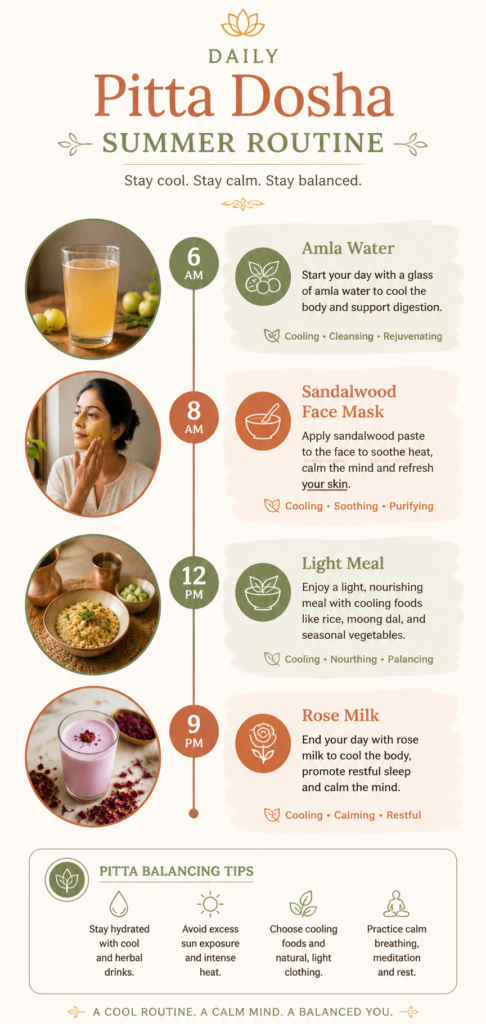
Morning (6–8 AM)
- Wake before the Pitta hour — rise by 6 AM to leverage the cooler Kapha period
- Tongue scraping + oil pulling with coconut oil (cooling Sheeta Virya)
- Drink: One glass of cool (not iced) water with ½ tsp Amla Powder and a squeeze of lime
- Skincare: Apply Sandalwood Powder paste (mixed with rose water) to face; leave 10 min; rinse
- Movement: Walk, swim, or gentle yoga — before 8 AM, never in peak sun (10 AM–4 PM)
Afternoon (12–2 PM)
- Eat your largest meal now — Pitta’s digestive power peaks at noon
- Avoid: Spicy food, vinegar, fermented items, excess salt, alcohol, caffeine
- Prefer: Sweet fruits, coconut, leafy greens, ghee in moderation, coriander-seasoned lentils
- Rest briefly (15–20 min) if possible — Ayurveda calls this Madhyahnika (midday pause)
Evening (7–9 PM)
- Light dinner — before 8 PM; soups, khichdi, or steamed vegetables
- Rose Powder drink: ½ tsp in warm oat or almond milk (supports Sadhaka Pitta cooling)
- Abhyanga: Self-massage with coconut oil on soles of feet and scalp (5 min)
Dosage guidance (hedged):
| Herb | Traditional Use Amount | Best Form | Best Time |
|---|---|---|---|
| Amla Powder | ½–1 tsp | Dissolved in cool water | Morning, empty stomach |
| Rose Powder | ½ tsp | Warm plant milk | Evening |
| Sandalwood Powder | 1–2 tsp topically | Mixed with rose water as paste | Morning skincare |
| Moringa Powder | ½–1 tsp | Smoothie, lassi, or warm water | Morning or noon |
Note: These are traditional use ranges. Always start with the smaller amount and observe your body’s response. Consult an Ayurvedic practitioner for personalised guidance.
Dos and Don’ts:
| ✅ DO | ❌ DON’T |
|---|---|
| Eat sweet, bitter, astringent foods | Eat spicy, sour, salty in excess |
| Exercise before 8 AM or after 6 PM | Exercise in peak sun (10 AM–4 PM) |
| Use cooling topicals (sandalwood, rose) | Use harsh chemical exfoliants on skin |
| Wear natural, light-coloured, breathable fabrics | Wear synthetic fibres that trap heat |
| Sleep by 10 PM (before Pitta night hour) | Scroll screens past 10 PM (activates Sadhaka Pitta) |
| Drink room-temperature or cool water | Drink ice-cold water (dampens Agni) |
The 3-Minute Pitta Dosha Summer Cooling Ritual
This is the section no competitor covers — and it’s the one that actually changes your skin.
Most routines tell you what to do across a whole day. This ritual takes just 3 minutes and can be done every evening before bed. Done consistently for 21 days, it may support noticeably calmer skin, reduced heat rashes, and a quieter mind.
H3: What You Need
- 1 tsp Suvarn Naturals Sandalwood Powder
- ½ tsp Suvarn Naturals Rose Powder
- 2–3 tbsp cold rose water or plain chilled water
- 1 small glass bowl
- A soft cloth or your fingertips
H3: The Steps
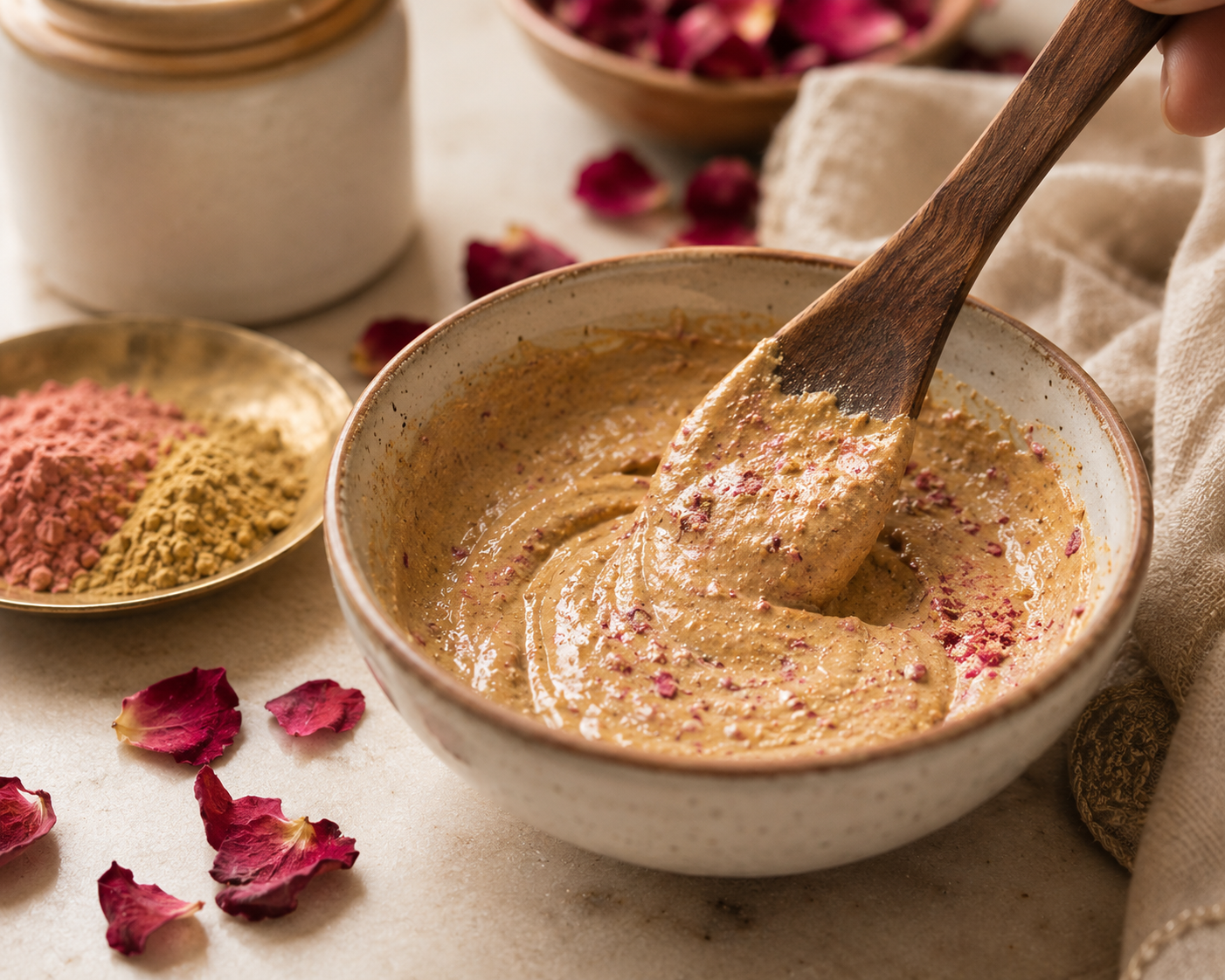
Step 1 (30 seconds): In the bowl, mix sandalwood and rose powder together dry. Notice the scent — it signals to your nervous system that it’s time to cool down. This is aromatherapeutic Nasya working passively.
Step 2 (30 seconds): Add cold rose water gradually, stirring until you get a smooth, spreadable paste — not too thin, not too thick.
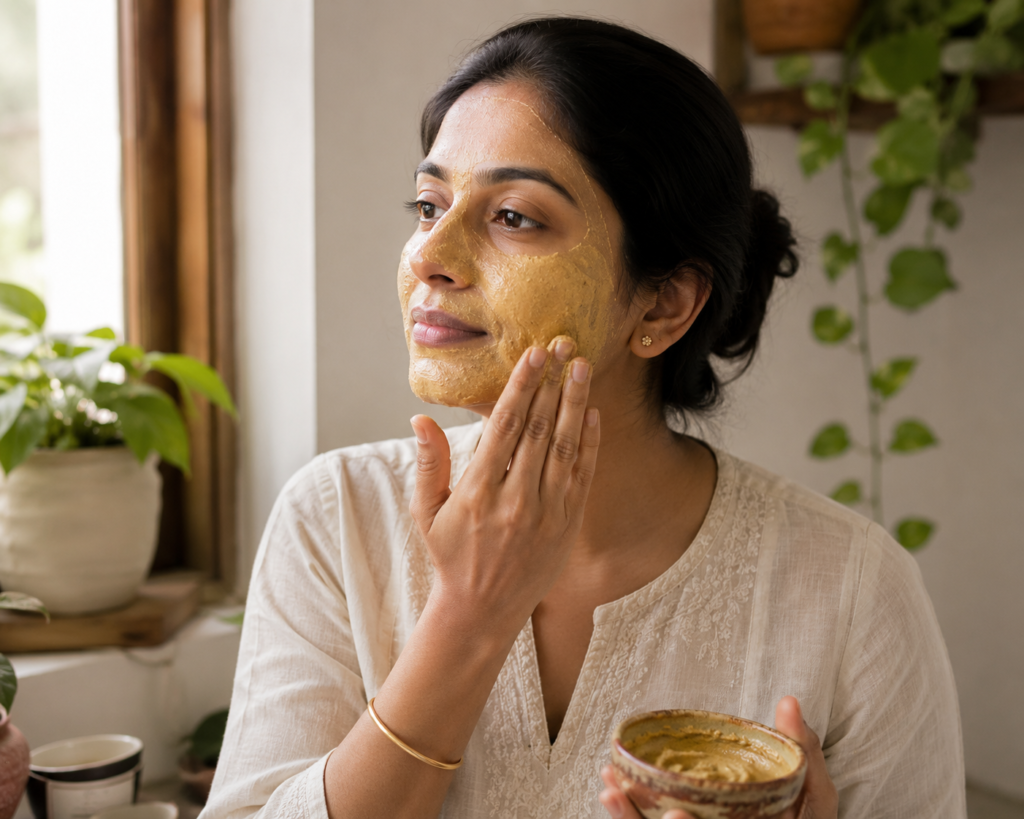
Step 3 (60 seconds): Apply to your face and neck using fingertips in gentle upward strokes. Focus on the forehead (Pitta accumulates here), the jawline (hormonal acne zone), and the back of the neck.
Step 4 (60 seconds — optional): While the mask sets, take 5 slow nasal breaths. Breathe in for 4 counts, hold for 2, out for 6. This activates the parasympathetic nervous system — the physiological equivalent of Pitta cooling.
Step 5: Rinse with cool water. Pat dry. No moisturiser needed if skin feels balanced; apply a few drops of coconut oil if the skin feels tight.
🌹 Pro tip: For extra Pitta-calming benefit on days when your skin feels extra reactive, add ½ tsp of Suvarn Naturals Rose Powder to a glass of cool water and drink it alongside your ritual. Rose is uniquely Hridya — it cools both the skin and the emotions simultaneously.
Pitta Dosha Summer Routine vs. Alternatives
| Feature | Suvarn Naturals Herbal Powders | Generic Branded Powders | Capsule Supplements | Synthetic Skincare |
|---|---|---|---|---|
| Ease of Use | Mix with water; 2 min prep | Similar | Swallow daily | Apply directly |
| Time to Visible Results | 3–6 weeks (skin + mood) | 3–6 weeks | 4–8 weeks | 1–3 days (surface only) |
| Skin Type Suitability | Pitta (sensitive, oily, combination) | Varies | All types | Often irritating for Pitta |
| PCOS-Friendliness | Amla + Moringa traditionally support hormonal balance | Inconsistent quality | Depends on formulation | Not targeted |
| Cost | Affordable; one pack lasts 4–6 weeks | Similar | Higher per-dose cost | High; multiple products needed |
| Transparency | Single-ingredient, traceable | Often blended; unclear sourcing | Excipients unknown | Multiple synthetic actives |
Suvarn Naturals products are presented as one well-researched option among many. What matters most is consistency, quality sourcing, and matching the herb to your specific imbalance.
Side Effects and Precautions
A Pitta dosha summer routine using food-grade Ayurvedic powders is generally well-tolerated. That said, here is what you should know:
Sandalwood Powder: Topically safe for most skin types. Rare contact dermatitis possible — do a patch test 24 hours before full application. Internal use of sandalwood is classical Ayurveda but not recommended without practitioner guidance.
Rose Powder: Very well-tolerated. Those with Rosa allergies (uncommon) should avoid. May mildly interact with sedative medications — consult your doctor if relevant.
Amla Powder: Generally safe. Due to its high Vitamin C content, very large amounts may cause loose stools in sensitive individuals. Avoid if you have low iron absorption concerns or are on blood thinners.
Moringa Powder: Avoid during pregnancy — Moringa leaves are traditionally contraindicated as they may stimulate uterine contractions. Safe for breastfeeding when used in food amounts, but consult a practitioner for higher doses.
Pregnancy and breastfeeding: Always consult a qualified Ayurvedic physician or your OB-GYN before beginning any herbal routine during these stages.
When to see a doctor: If your summer symptoms include severe abdominal pain, unexplained rashes, significant menstrual irregularity, prolonged insomnia, or mental health shifts — please seek professional care. These routines support wellness; they are not medical treatment.
Myths and Mistakes Women Make with the Pitta Dosha Summer Routine
Myth 1: “I’ll just drink cold water and avoid spice — that’s enough.”
Cold water temporarily cools the body surface but doesn’t address Bhrajaka Pitta (skin inflammation) or Ranjaka Pitta (hormonal heat). And ice-cold water can actually weaken Agni, causing digestive distress — the opposite of what Pitta needs. Cooling potency (Sheeta Virya in herbs) is different from temperature.
Myth 2: “If I’m not a Pitta type, summer doesn’t affect me.”
Summer aggravates Pitta in everyone — regardless of constitution. Vata types may experience summer anxiety or dehydration; Kapha types may experience heat-induced lethargy. The Pitta dosha summer routine’s core tools (cooling herbs, early rising, light diet) benefit all constitutions in the hot months.
Myth 3: “Sandalwood is only for fair skin.”
This is a persistent — and incorrect — cultural myth. Sandalwood (Chandana) is a Pitta-pacifying, anti-inflammatory herb. Its bioactives (α-santalol, β-santalol) work on skin inflammation and sebum regulation regardless of skin tone. Charak Samhita recommends Chandana for all Pitta-type skin conditions without any mention of complexion.
Myth 4: “Ayurvedic routines take hours — I don’t have time.”
The 3-minute ritual in this article takes less time than scrolling Instagram. The daily additions (½ tsp Amla in water, rose milk at night) add maybe 5 minutes total. Consistency, not duration, is the Ayurvedic principle of Nityacharya (daily routine).
Myth 5: “Summer acne is just hormonal — herbs won’t help.”
This is the big oversimplification in competing content. Summer acne often is hormonal — but hormonal imbalance in summer is frequently Pitta-mediated (Ranjaka Pitta dysregulating Rakta Dhatu). Addressing the Pitta root cause topically AND internally creates a more complete response than either approach alone.
Notes from the Suvarn Naturals Founder
In the words of our founder:
“While exploring traditional wellness practices, we became fascinated by how seasonal routines were connected to everyday ingredients. Summer-inspired rituals using cooling herbs and botanicals felt simple, grounding, and easy to include in daily life. That inspiration continues to influence how we choose products at Suvarn Naturals.”
When we first began sourcing Sandalwood Powder, one of the things that struck us immediately was the scent. Real Mysore sandalwood (Santalum album) has a deep, woody, slightly creamy note — nothing like the synthetic sandalwood fragrance most people have encountered in soaps or incense. When the scent is right, the potency of the bioactives (α-santalol and β-santalol) is right too. We test for both.
Our Rose Powder is made from Rosa damascena petals — not the commercially grown variety sprayed with post-harvest preservatives, but sun-dried petals processed at low temperature to preserve the Hridya (heart-nourishing) volatile compounds that make rose genuinely therapeutic, not just pleasant-smelling.
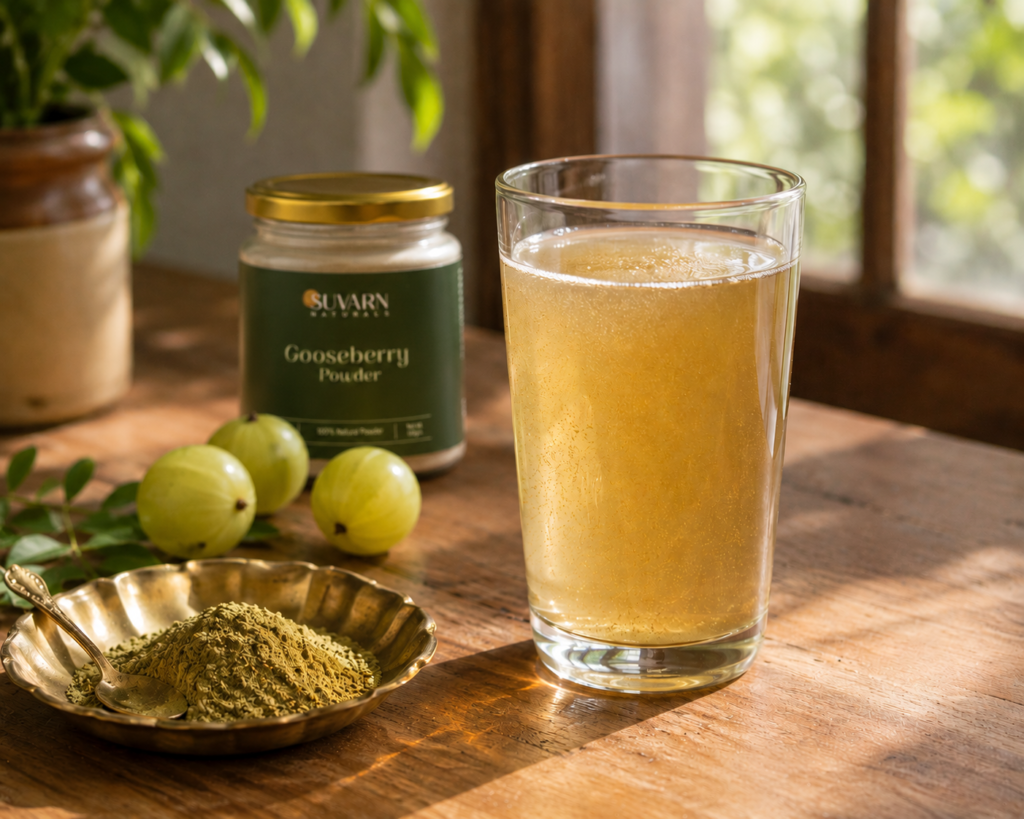
With Amla Powder, the challenge is always oxidation. Amla is rich in Vitamin C — but Vitamin C degrades fast with heat and light. We cold-process and package in UV-resistant pouches for this exact reason. When our Amla Powder hits cool water and turns light amber, that’s live Vitamin C at work.
Moringa Powder was the last addition to our summer ritual set. We were initially focused on its nutrition profile — but the feedback from women who used it for hair fall was striking enough that it’s now a core part of how we think about summer Pitta support.
Every batch is tested. Every ingredient is traceable. That’s not a marketing line — it’s the baseline we set for ourselves on day one.
See all Suvarn Naturals herb powders →
FAQs — Shikakai vs Shampoo
Q1: How quickly will I see results from a Pitta dosha summer routine?
Most women notice changes in energy and mood within 7–10 days. Skin improvements (reduced redness, fewer breakouts) typically become visible within 3–4 weeks of consistent practice. Internal benefits like improved digestion and more stable hormones are usually felt around the 6-week mark. Ayurveda works with your body’s natural tissue-renewal cycles — patience is part of the practice.
Q2: Can I follow a Pitta dosha summer routine if I have PCOS?
Yes — and for many women with PCOS, it may be especially relevant. A 2024 study in Cureus directly linked Pitta imbalance to PCOS symptoms including hormonal irregularities and inflammation. Cooling herbs like Amla (supportive of liver and hormonal metabolism) and Rose (Hridya, calming) are traditionally used in PCOS-adjacent Ayurvedic protocols. Always consult your gynaecologist alongside any herbal additions.
Q3: Is sandalwood powder safe for daily use on the face?
For most skin types, yes — when used as a face mask 3–4 times per week. Daily use (every single day) isn’t traditional Ayurvedic practice; alternating with plain rose water or aloe vera on off-days is a more balanced approach. Always do a patch test first. If you experience redness or itching, discontinue and consult a dermatologist.
Q4: What’s the difference between Pitta dosha summer routine and a regular summer skincare routine?
A conventional summer skincare routine treats symptoms on the skin surface (SPF, oil control, hydration). A Pitta dosha summer routine works systemically — addressing the internal heat, hormonal environment, digestive comfort, and emotional state that create those skin symptoms. Think of it as upstream skincare: fix the source, and the surface follows.
Q5: Can men follow a Pitta dosha summer routine?
Absolutely. Pitta aggravation in summer affects men equally — summer acne, acid reflux, irritability, and scalp inflammation are all common presentations. The herbs (Amla, Moringa, Rose, Sandalwood) and lifestyle principles apply universally. Men may prefer the Moringa powder in a simple smoothie and the Amla water over the rose milk variation.
Q6: Can I take Amla powder and Moringa powder together?
Yes — these two herbs are classically complementary. Amla’s cooling, Vitamin C-rich profile pairs well with Moringa’s nutrient density (iron, zinc, antioxidants). Start with ½ tsp of each separately first to observe your body’s response before combining. Take Amla in the morning on an empty stomach; Moringa can be taken at breakfast or noon.
Q7: What should I eat on a Pitta dosha summer routine?
Focus on sweet, bitter, and astringent tastes (Madhura, Tikta, Kashaya Rasa). Practical foods: cucumber, coconut water, sweet fruits (pear, melon, mango in moderation), leafy greens, coriander, fennel, cool lassi (not too sour), rice, moong dal, and ghee. Limit or avoid: spicy food, fermented items, excess salt, alcohol, red meat, and very sour foods (except Amla — it is uniquely cooling despite its sour taste).
Q8: Is it safe to do the Sandalwood + Rose face mask during pregnancy?
Topical use of sandalwood and rose water on the skin is generally considered safe during pregnancy. However, avoid any internal herbal supplementation (Amla powder, Moringa powder) without consulting your OB-GYN or Ayurvedic physician first. When in doubt, err on the side of caution and seek personalised advice.
Q9: My skin is already oily — won’t adding a paste make it worse?
No. Sandalwood has astringent (Kashaya Rasa) properties that actually regulate sebum and tighten pores. This is why it’s traditionally prescribed for Snigdha (oily, lustrous) Pitta skin — it removes excess oil while cooling inflammation, without the stripping effect of modern clay masks. The key is to rinse thoroughly and not over-apply.
Q10: What’s the best time to start a Pitta dosha summer routine in India?
Start in late March or early April — just as the pre-summer heat begins. By the time peak summer hits (May–June), your body’s cooling systems will already be supported. If you’re starting in May or June, that’s fine too; begin immediately and stay consistent through September when Pitta season transitions.
Final Takeaway
Summer in India is beautiful — and intense. Your body feels that intensity first through your skin, your gut, your mood, and your hormones. A Pitta dosha summer routine is not a complicated overhaul. It’s a few daily additions: a cooling herb in your morning water, a 3-minute face ritual in the evening, a lighter dinner, and an earlier bedtime.
Start with one change. Notice how your body responds. Then layer the next one. Ayurveda’s greatest wisdom is not in complexity — it’s in consistency with the right ingredients at the right season.
Your summer can feel grounded, clear-skinned, and calm. It just needs a little Pitta-cooling intention.
🌿 Explore Suvarn Naturals’ cooling herb powders for your summer routine →
References:
Charak Samhita, Sutrasthana, Chapter 6 (Tasyashiteeya Adhyaya) — on seasonal routines (Ritucharya)
Jadhav R, et al. (2024). Characteristics of PCOS: A Case Report Investigating the Role of Kapha and Pitta Doshas. Cureus. DOI: 10.7759/cureus.54342. PMC10945471.
Francois-Newton V, et al. (2021). Antioxidant and Anti-Aging Potential of Indian Sandalwood Oil. Cosmetics, 8(2), 53.
IJRPR (2025). Beneficial Effects of Sandalwood (Santalum album) for Skin Health: Anti-inflammatory, Antimicrobial, and Antioxidant Properties.
Sandu Pharmaceuticals. Ayurvedic Dietary Guidelines to Pacify Pitta Dosha in Summer. https://sandu.in