Dandruff vs Dry Scalp: How to Tell the Difference, Causes, Symptoms & What to Do

Published: 24 August 2026 | By Suvarn Naturals Team
TL;DR
- Dandruff and dry scalp both cause flaking and itching, but they usually have opposite root causes — dandruff is linked to excess oil and an overgrowth of the Malassezia yeast, while dry scalp is linked to moisture loss.
- Dandruff flakes tend to be larger, oilier, and yellow-white; dry scalp flakes tend to be smaller, drier, and whiter, often alongside dry skin elsewhere on the body.
- The right fix depends on the cause: dandruff generally responds to antifungal or keratolytic ingredients (like ketoconazole, zinc pyrithione, or salicylic acid); dry scalp responds better to gentle cleansing and moisture.
- Persistent redness, swelling, spreading patches, or flaking that doesn’t improve after a few weeks of consistent home care is a signal to see a dermatologist, since conditions like seborrheic dermatitis, psoriasis, or eczema can look similar.
- Ayurveda has long addressed flaky, itchy scalp conditions (broadly grouped under Darunaka) using cleansing and balancing herbs — this is a traditional framework, not a substitute for medical diagnosis when symptoms are severe or persistent.
- This guide is educational, not a diagnosis. If you’re unsure which condition you have, a scalp check with a dermatologist is the most reliable way to find out.
Why flakes on your scalp aren’t always the same problem
Dandruff vs dry scalp: If you’ve ever brushed your shoulder and found white flakes there, you’ve probably assumed “dandruff.” But flaking on the scalp has more than one cause, and the two most common — dandruff and a genuinely dry scalp — need different care. Treat one like the other and you can end up stuck in a loop: stripping an already-dry scalp with harsh anti-dandruff shampoo, or moisturizing an oily, yeast-driven scalp in a way that makes the flaking worse.
This guide walks through what separates the two conditions, what’s currently understood about their causes, how people commonly try to tell them apart at home, and when the smarter move is to stop guessing and see a dermatologist. Where herbal or Ayurvedic approaches are mentioned, we’ve been careful to separate traditional use from clinical evidence — because your scalp deserves an honest answer, not a marketing one.
What is dandruff, and what is dry scalp? (Direct answer)
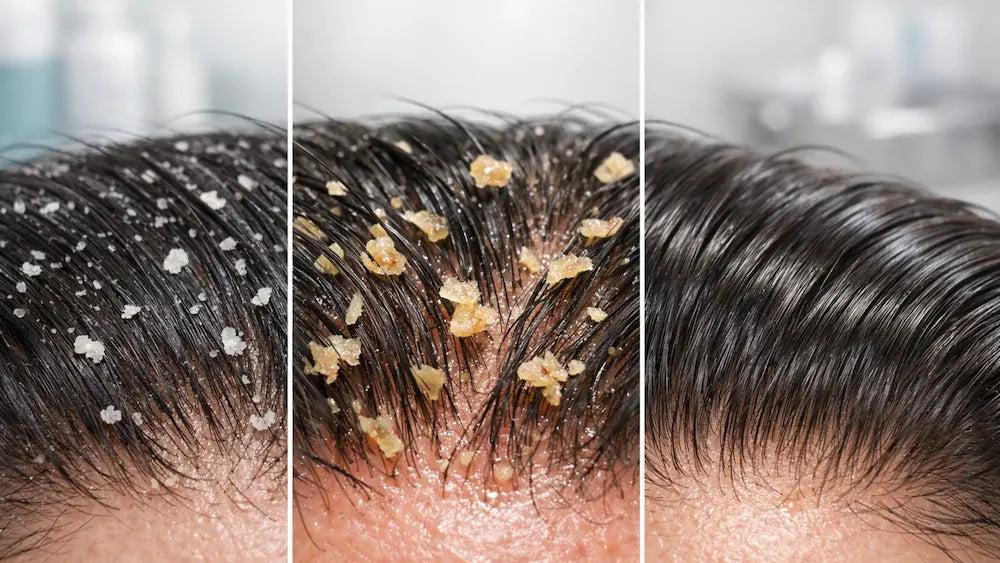
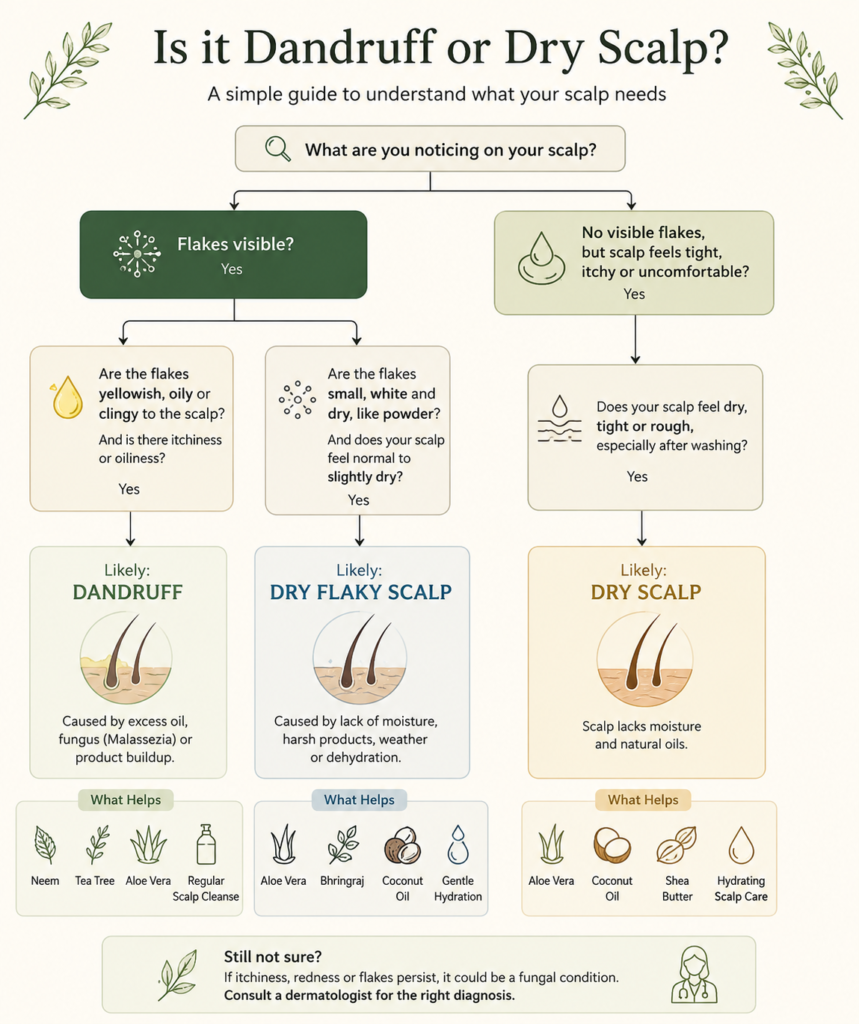
Dandruff is a common scalp condition in which skin cells shed faster than normal, producing visible flakes. It’s widely linked to three overlapping factors: sebum (oil) on the scalp, an overgrowth of a yeast called Malassezia that lives on everyone’s skin, and individual sensitivity/inflammatory response to that yeast. In its more inflamed form, this same process is called seborrheic dermatitis. Flakes are typically larger, oilier, and whitish-yellow, and the scalp itself often looks oily rather than dry.
Dry scalp is, as the name suggests, simply skin on the head that has lost too much moisture — the same underlying process as dry skin on your elbows or shins. It can be triggered by harsh shampoos, over-washing, cold or dry weather, ageing skin, or product build-up that strips natural oils. Flakes tend to be smaller, drier, and whiter, and the scalp usually feels tight or itchy rather than greasy.
Both conditions can occur without visible inflammation, but both can also become more inflamed and start to resemble each other — which is exactly why they get confused so often.
Dandruff vs dry scalp: symptom comparison
| Signal | Dandruff | Dry scalp |
|---|---|---|
| Flake size/texture | Larger, oilier, may clump | Smaller, drier, powdery |
| Flake colour | White to yellowish | White |
| Scalp feel | Often oily, may be itchy or inflamed | Tight, itchy, sometimes flaky like other dry skin |
| Where else it shows up | Can extend to eyebrows, sides of nose, ears, beard/chest (seborrheic areas) | Usually scalp-only, though often paired with dry skin elsewhere on the body |
| Common triggers | Excess oil, yeast overgrowth, stress, infrequent washing, hormonal shifts | Harsh shampoo, over-washing, cold/dry air, hard water, ageing |
| Typical relief approach | Antifungal or keratolytic ingredients (ketoconazole, zinc pyrithione, selenium sulfide, salicylic acid) | Gentle, sulfate-light cleansers plus scalp moisture; washing less aggressively |
If you’re still unsure, one simple (not diagnostic) home check some dermatology sources describe: apply a light, unscented moisturizer or oil to the scalp before bed. If flaking and itching noticeably ease, moisture loss was likely playing a bigger role. If flaking persists or the scalp still looks oily and irritated, an oil/yeast-driven process is more likely at work. This is a helpful clue, not a diagnosis.
What actually causes each one
Dandruff — what research points to
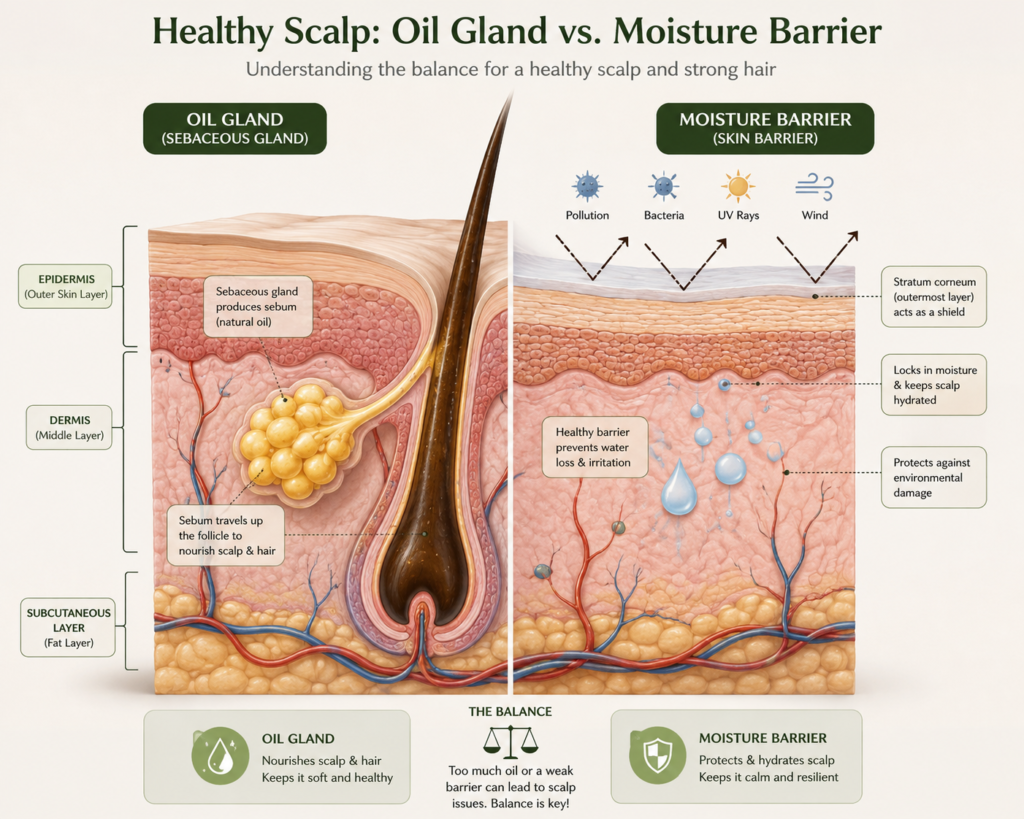
Dandruff is understood to involve three interacting factors: sebum (oil) production, colonisation by Malassezia yeast species, and how sensitively an individual’s skin reacts to that yeast with inflammation and faster cell turnover. Genetics, stress, hormonal changes, humidity, and infrequent hair washing are commonly cited contributors, and dandruff can flare or improve seasonally. When the inflammatory component is more pronounced — redness, greasy scale, spreading to eyebrows or the sides of the nose — it’s usually described clinically as seborrheic dermatitis rather than “simple” dandruff, though the two sit on a spectrum.
Dry scalp — what research points to
Dry scalp happens when the skin’s outer barrier loses water faster than it can replace it. Cold or low-humidity air, hot showers, over-washing, sulfate-heavy shampoos, harsh styling products, hard water, and simply ageing skin (which produces less oil over time) are all recognised contributors. Because it’s a moisture-barrier issue rather than a yeast-driven one, dry scalp is also more likely to appear alongside dry skin on the rest of the body.
Conditions that can look like either one
A dermatologist can also rule out — or identify — look-alike conditions such as scalp psoriasis (thicker, silvery scaling, sometimes with well-defined patches), seborrheic dermatitis (greasier, more inflamed, may spread beyond the scalp), and contact dermatitis (a reaction to a specific hair product, causing localised redness and itch). None of these should be self-diagnosed from a symptom list alone — including this one.
The Ayurvedic perspective
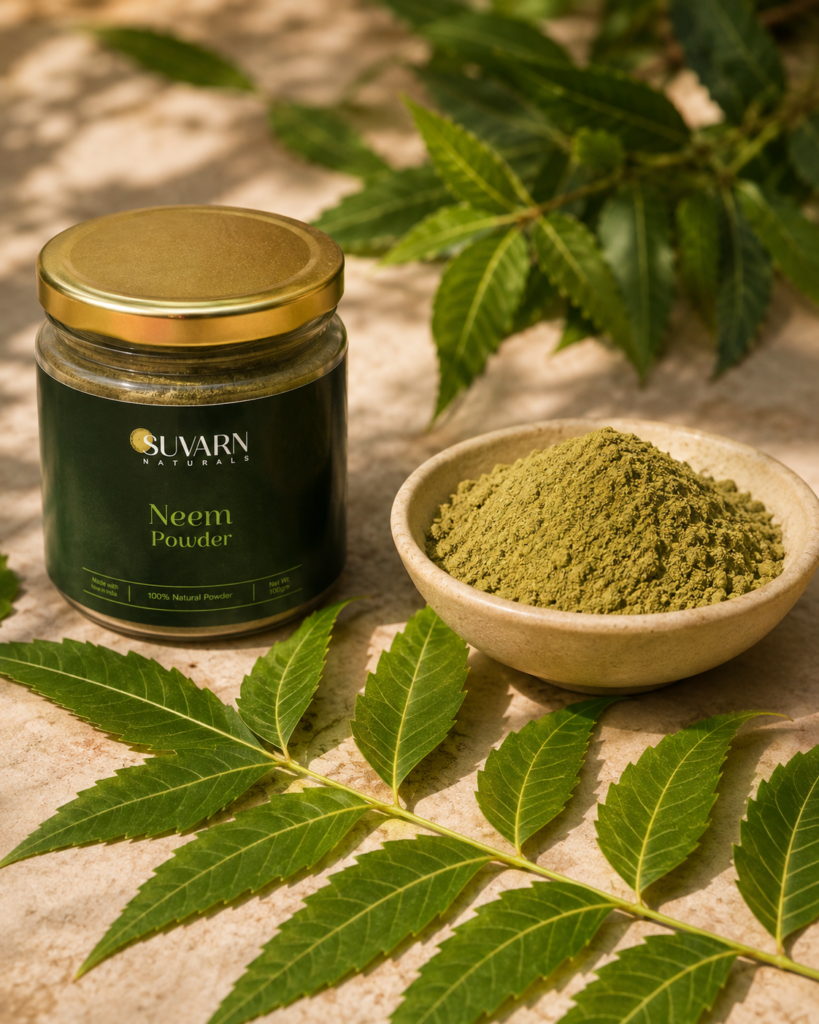
In Ayurveda, chronic dry, flaking, and itchy scalp conditions are broadly discussed under the term Darunaka, generally associated with aggravated Vata and Kapha affecting the scalp’s nourishment and oil balance. Traditional practice for this category of scalp concern has long emphasised gentle cleansing with herbal powders, scalp oiling before washing, and the use of astringent, purifying botanicals such as neem (Azadirachta indica) for oilier, congested scalps.
This is traditional-use knowledge passed down over generations, not a clinical diagnosis or a claim of proven efficacy against seborrheic dermatitis or fungal overgrowth in the modern medical sense. If your flaking is oily, itchy, and yeast-associated, a traditional cleansing ritual can be a reasonable complement to — not a replacement for — antifungal treatment when a dermatologist has recommended one.
What does modern research say about treatment?
Evidence quality varies by ingredient, so it’s worth separating the levels:
Strong evidence (clinical trials): Antifungal shampoo ingredients — particularly ketoconazole 2%, along with zinc pyrithione and selenium sulfide — have been tested in multiple randomized, controlled or double-blind trials for dandruff and seborrheic dermatitis, generally showing meaningful reductions in flaking, itching, and redness over 2–4 weeks of consistent use. Head-to-head trials have found ketoconazole 2% shampoo statistically superior to zinc pyrithione 1% shampoo in some studies, though both are considered effective, evidence-backed options.
Traditional use (not clinical evidence): Neem and other Ayurvedic botanicals have a long history of topical use for oily, congested, or itchy scalps in Indian households, and neem leaf is traditionally regarded as cleansing and purifying. This traditional use does not mean neem powder has been clinically proven to treat seborrheic dermatitis or reduce Malassezia levels to the same standard as a medicated shampoo — research specifically on neem’s effect on scalp yeast is limited, and no claim here should be read as equivalent to a drug’s clinical evidence base.
For dry scalp specifically: There isn’t the same body of pharmaceutical trial evidence, mainly because dry scalp is a barrier/moisture issue rather than a disease process — the practical, widely recommended approach is simply gentler cleansing, moisture-supportive routines, and identifying/removing the irritant (harsh shampoo, over-washing, hot water) causing the dryness.
Who may find each type of care useful
- If your scalp looks/feels oily, flakes are larger and yellowish, and itching comes with some redness: a dandruff-focused routine (gentle but effective cleansing, and — if recommended by a pharmacist or dermatologist — a medicated antifungal shampoo) is generally the more appropriate starting point.
- If your scalp feels tight, flakes are small and dry, and you also have dry patches elsewhere on your body: a moisture-first, gentle-cleansing routine is generally the more appropriate starting point.
- If you’re not sure, symptoms overlap, or nothing is improving after a few weeks: this is exactly the situation a dermatologist is best placed to sort out — guessing wrong can prolong the problem.
Who should be cautious or seek professional care first
- Anyone with redness, swelling, pain, oozing, or crusting on the scalp
- Anyone whose flaking or itching is spreading beyond the scalp (eyebrows, ears, chest, hairline)
- Anyone with noticeable hair thinning or hair loss alongside scalp symptoms
- Anyone who has tried consistent, appropriate home care for 2–4 weeks with no improvement
- Pregnant or breastfeeding individuals, before starting any new medicated shampoo or herbal scalp treatment — check with a doctor first
- Anyone with known sensitivities to fragrance, essential oils, or specific botanical ingredients
Practical scalp-care basics
For a likely dandruff pattern:
- Wash regularly enough to prevent oil and product build-up — for many people this means several times a week rather than skipping washes to “protect” the scalp.
- Look for cleansers formulated around recognised antidandruff ingredients (ketoconazole, zinc pyrithione, selenium sulfide, or salicylic acid) and follow the label’s contact time and frequency.
- Avoid layering multiple heavy oils or styling products directly onto an already oily, flake-prone scalp.
For a likely dry-scalp pattern:
- Switch to a gentle, sulfate-light shampoo and avoid over-washing, which can strip the scalp further.
- Use lukewarm rather than hot water, since heat accelerates moisture loss.
- Consider a light pre-wash oil application or a moisturizing conditioner focused on the scalp, not just hair lengths.
- In dry, low-humidity months, a humidifier at home can help the skin (scalp included) hold on to moisture.
India-specific notes: Humid coastal climates can worsen oil-and-yeast-driven dandruff, while dry winters in northern India, hard water, and frequent hot-water washes can worsen dry scalp. If your household has hard water, that alone can leave both hair and scalp feeling stripped and irritated regardless of which condition you have — worth ruling in or out before assuming it’s dandruff.
Common mistakes and myths
| Myth | What the evidence actually shows |
|---|---|
| “Dandruff means my scalp is dirty.” | Dandruff is linked to oil and yeast activity, not poor hygiene — over-scrubbing can actually irritate the scalp further. |
| “If my scalp flakes, I must have dry skin, so I should oil it heavily.” | If the flaking is actually yeast/oil-driven dandruff, adding heavy oil can feed the problem rather than solve it — this is why telling the two apart matters. |
| “Dandruff is contagious.” | Dandruff is not contagious; Malassezia yeast naturally lives on most people’s skin already. |
| “Natural or herbal shampoos always work better for scalp conditions than medicated ones.” | Herbal ingredients can play a genuine supportive, traditional role, but for a confirmed fungal or inflammatory scalp condition, ingredients with clinical trial evidence (like ketoconazole or zinc pyrithione) have a stronger evidence base for that specific job. |
Notes from the Suvarn Naturals founders
Growing up, neem was never something we bought — it was something that grew in the courtyard, and our mothers and grandmothers reached for it the moment anyone in the house had scalp trouble. That’s really where our neem powder comes from: not a lab brief, but a habit we grew up watching and later chose to bring into Suvarn Naturals.
A lot of the people who write to us about our neem powder aren’t dealing with dry, tight scalps — it’s usually the opposite. They describe an oily scalp, flakes that stick together rather than falling away easily, and a scalp that feels congested by the end of the week. That’s the profile neem has traditionally been used for, and it’s why we’re careful to say it’s not the right fit for every kind of flaking — if your scalp genuinely feels dry and tight rather than oily, this isn’t the powder we’d point you to first.
We keep the process simple on purpose: the powder is meant to be mixed into a paste and used as an occasional pre-wash treatment, not a daily strip-everything routine. And we say this often, because we mean it — if your scalp is inflamed, sore, or not improving despite consistent care, please see a dermatologist before reaching for any powder, ours included. We built Suvarn Naturals around traditional ingredients we trust, not around replacing medical care.
— Vidhi & Virti, Founders, Suvarn Naturals
Frequently Asked Questions
Can I have dandruff and dry scalp at the same time?
Yes — it’s possible for an oily, yeast-driven area to coexist with genuinely dry patches, especially if harsh anti-dandruff products have over-dried the scalp. This is one more reason a professional opinion helps when symptoms don’t fit neatly into one category.
Does diet cause dandruff or dry scalp?
There’s no strong, consistent clinical evidence tying a specific diet to causing or curing dandruff, though general skin and scalp health benefits from adequate hydration and a balanced diet. Be wary of any claim promising a specific food or supplement will “cure” dandruff.
How long does it take to see improvement?
With consistent, appropriately matched care, many people notice improvement within 2–4 weeks. If there’s no change in that window, it’s a reasonable point to consult a dermatologist rather than continuing to guess.
Is dandruff worse in winter?
Many people notice more flaking in colder, drier months — but this can reflect either dandruff or dry scalp becoming more pronounced, so it isn’t a reliable way to tell the two apart on its own.
When should I actually see a dermatologist?
See a dermatologist if you notice redness, swelling, pain, spreading beyond the scalp, hair thinning, or no improvement after a few weeks of consistent, appropriate home care. A quick scalp examination can rule in or out conditions like seborrheic dermatitis, psoriasis, or eczema that need a different approach entirely.
Final takeaway
Flaky scalp isn’t one problem — it’s at least two, with mostly opposite causes and opposite fixes. Dandruff tends to be an oil-and-yeast story; dry scalp tends to be a moisture story. Matching your routine to the right one (and getting a professional opinion when it’s unclear or persistent) will get you further than any single “miracle” product. Traditional Ayurvedic cleansing routines, including neem-based scalp care, can be a reasonable, time-tested complement for oily, dandruff-prone scalps specifically — used alongside, not instead of, medical treatment when that’s what your scalp actually needs.
This article is for general information and is not a substitute for a diagnosis from a qualified dermatologist.