
Healthier Hair with Shikakai vs Shampoo: The Ayurvedic Truth Your Scalp Needs

Published: 25 May 2026 | By Suvarn Naturals Team
TL;DR — Key Takeaways
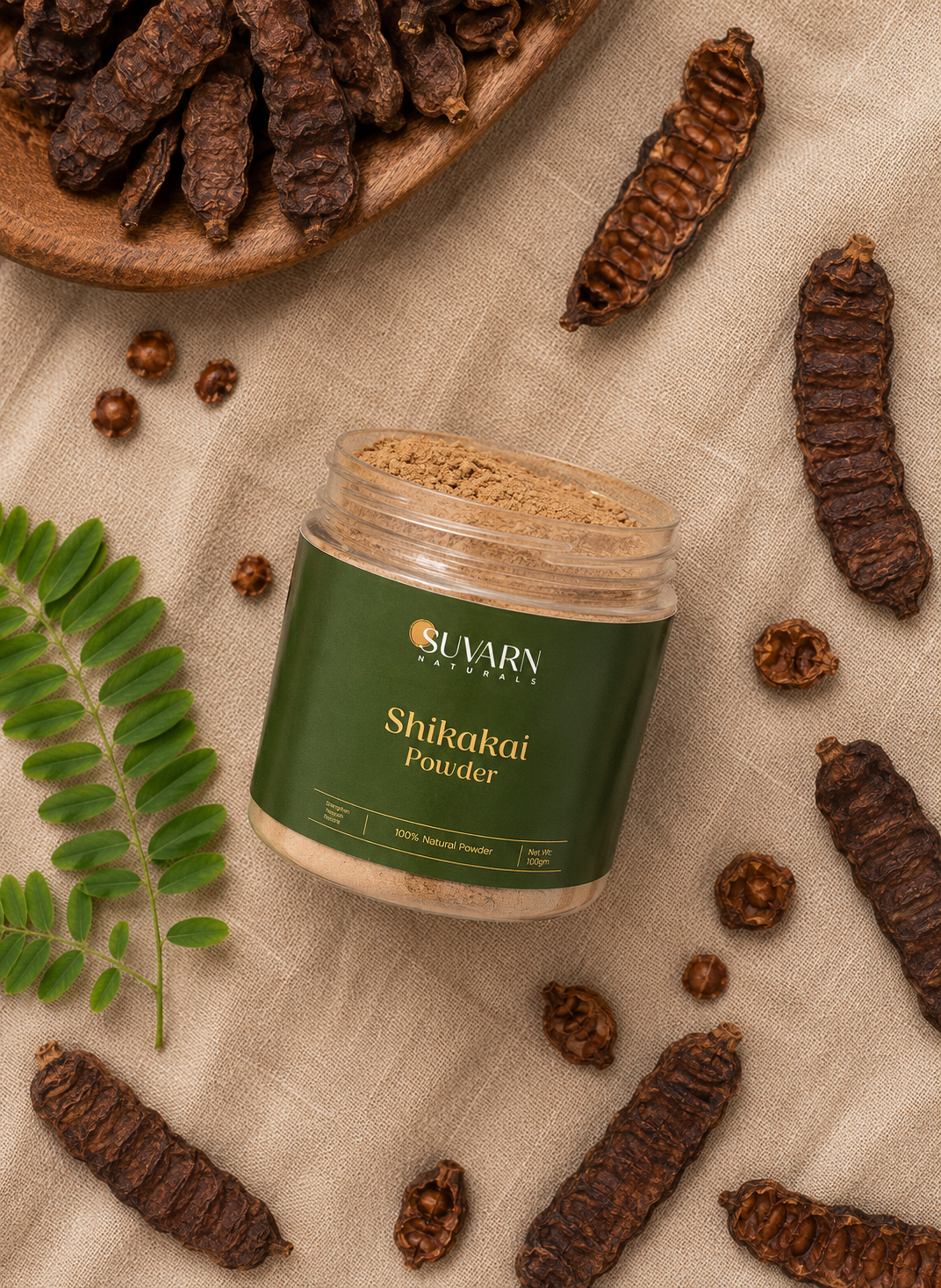
Try it: Suvarn Naturals Shikakai Powder — raw, single-ingredient, no additives.
Shikakai (Acacia concinna) is a plant-based cleanser that uses saponins — nature’s own surfactants — instead of synthetic sulfates.
Regular shampoos strip the scalp’s natural oils and disrupt its acid mantle; Shikakai’s low pH cleanses gently without that damage.
Shikakai may support hair growth, dandruff reduction, and scalp health, especially for women dealing with hormonal hair fall or a sensitive scalp.
It works best in powder form, mixed with water or combined with Amla for extra nourishment.
The transition from shampoo to Shikakai takes 2–3 weeks of adjustment — low lather is normal, and it does not mean less clean.
What Is Shikakai vs Shampoo?
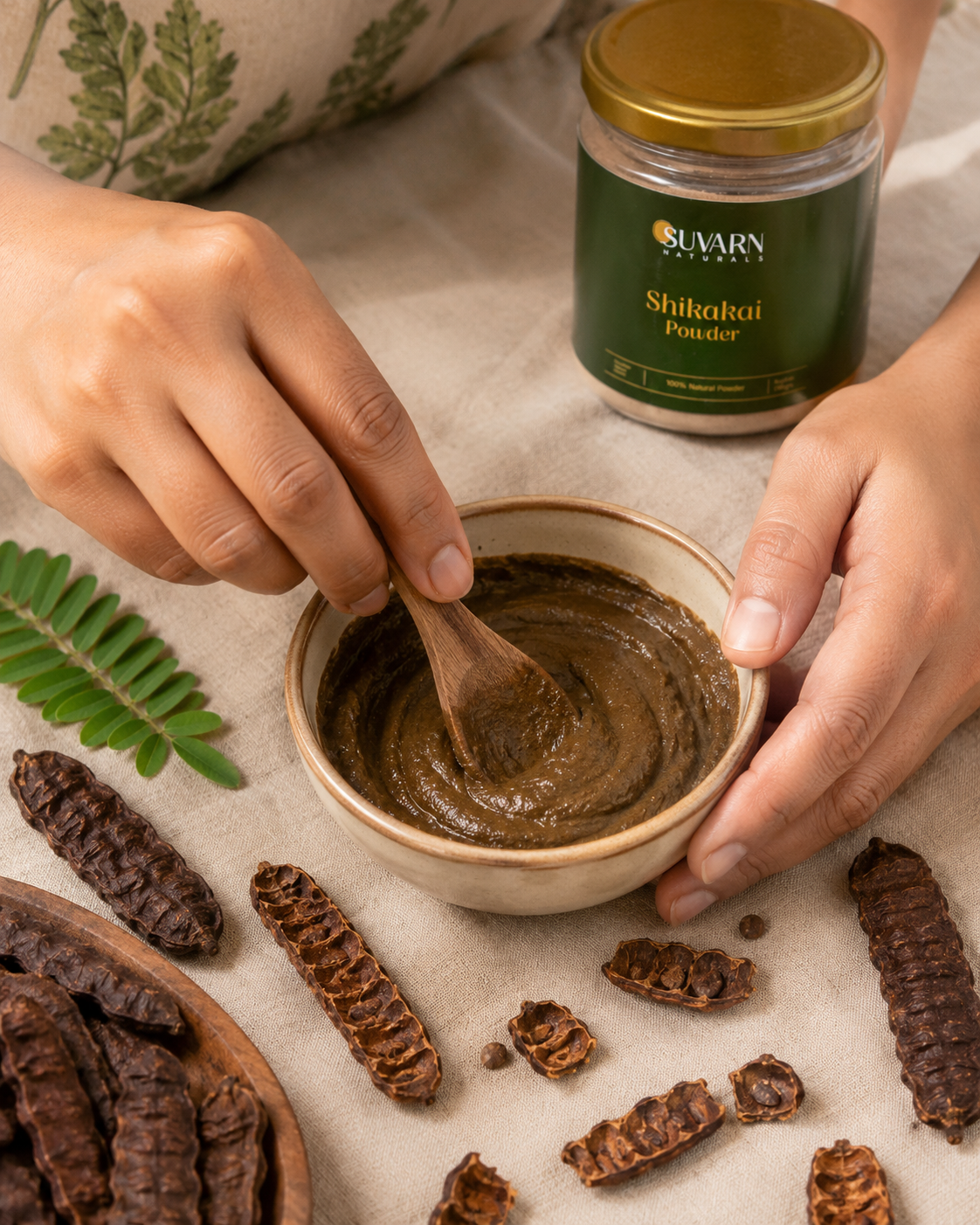
Shikakai vs shampoo is one of the most searched hair care questions among Indian women today — and for good reason. Shikakai (Acacia concinna) is a tropical climbing shrub whose sun-dried pods have been ground into a hair-cleansing powder for thousands of years. Commercial shampoo, by contrast, is a modern formulation that typically relies on synthetic sulfates like sodium lauryl sulfate (SLS) to create foam and clean hair.
The core difference: Shikakai cleanses through saponins — plant compounds that act as mild, biodegradable surfactants. Shampoo cleanses through synthetic detergents that are far more aggressive.
In Ayurveda, Shikakai is called “Saptala” or translated directly as “phal for kesh” — the “fruit for hair.” It is classified as a Keshya herb in classical texts like Charaka Samhita and Sushruta Samhita, meaning it specifically nourishes and strengthens the hair.
Botanical name: Acacia concinna (also reclassified as Senegalia rugata) Key constituents: Saponins, tannins, flavonoids, vitamins A, C, D, E, and K
The Science and Ayurvedic Perspective
When you choose Shikakai over shampoo, you are choosing a fundamentally different mechanism of cleansing. Understanding this difference is what makes the switch feel logical — not just trendy.
How Saponins Work
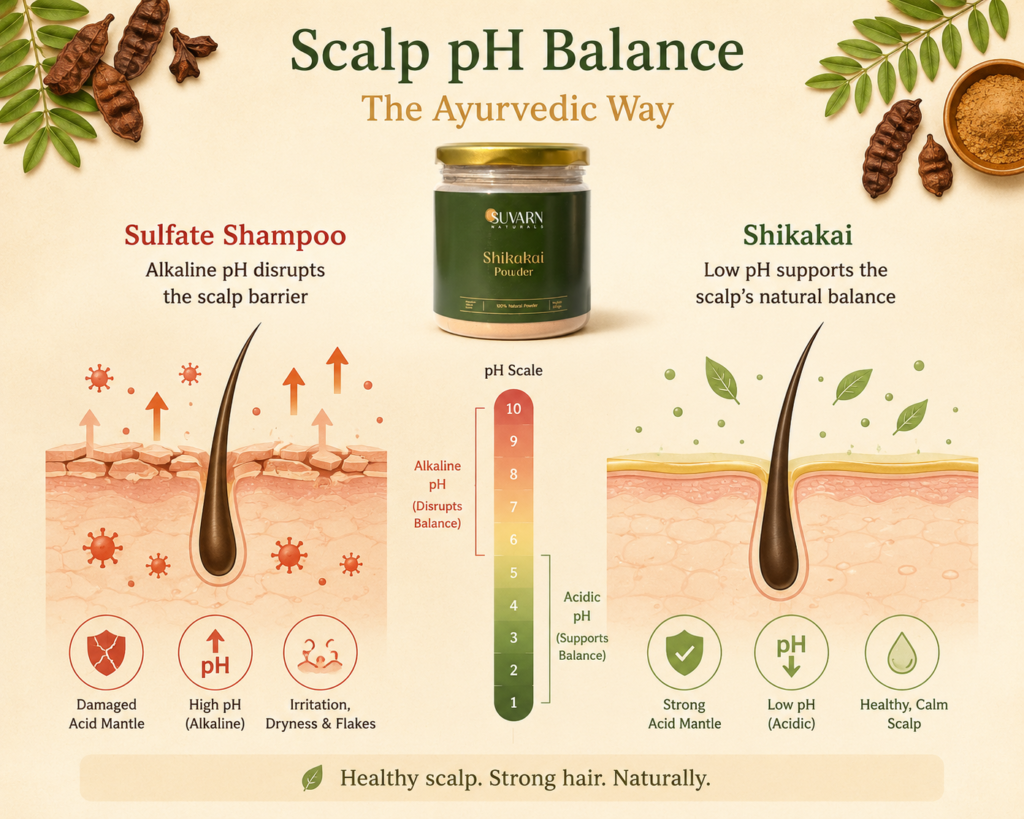
Saponins are amphiphilic molecules — they attract both water and oil simultaneously. This allows them to surround dirt and sebum and rinse it away without destroying the acid mantle, the thin protective film on your scalp that sits at a natural pH of 4.5–5.5.
Most commercial shampoos have a pH of 6–9. Every wash subtly disrupts your scalp’s acid mantle, leaving hair porous and frizzy, and prompting the sebaceous glands to overproduce oil to compensate. This is why many people find their hair gets greasy faster over time with regular shampoo use.
Shikakai has a naturally low, mildly acidic pH that aligns closely with the scalp’s own environment. It cleanses without destabilising the acid mantle.
A 2024 pharmaceutical formulation study published in the World Journal of Pharmaceutical Research confirmed that Shikakai and Soapnut (Reetha) together create a naturally surfactant-active, non-irritant formula — with effective foaming, good washability, and antimicrobial properties — comparable to commercial products but free of sulfates and parabens.
Ayurvedic Dosha Context
In Ayurveda, hair fall and scalp inflammation are most commonly linked to excess Pitta dosha — heat, inflammation, and acidity in the body. Shikakai is considered a cooling, Pitta-pacifying herb. Its mild bitterness and astringency help balance excess heat on the scalp, which may explain why it has traditionally been used by women experiencing hair fall triggered by hormonal shifts, stress, or post-partum changes.
Women with a Vata-dominant constitution — prone to dry, brittle, frizzy hair — also benefit significantly, because Shikakai cleanses without stripping the scalp’s natural lipids.
Myth vs Fact
| Myth | Reality |
|---|---|
| “No foam = not clean” | Saponins clean effectively at low lather. Foam is a cosmetic feature, not a cleansing indicator. |
| “Shikakai is only for oily hair” | It suits all hair types — low pH and gentle saponins are as beneficial for dry, frizzy hair as for oily scalps. |
| “You must use Shikakai daily for results” | Once or twice a week is optimal. Overuse can cause mild dryness in very low-moisture hair types. |
Benefits of Shikakai vs Shampoo — Especially for Women
May Support Reduced Hair Fall
Hair fall in women is often triggered by hormonal fluctuations — PCOS, thyroid imbalance, postpartum changes, or perimenopause. These conditions weaken hair follicles at the root. Shikakai’s saponins and tannins may help strengthen hair from the follicle, while its vitamins A and C support collagen synthesis in the scalp dermis — the structural base that anchors each strand.
Quick tip: Mix Suvarn Naturals Shikakai Powder with Amla Powder for an added vitamin C and tannin boost — this combination is one of the most time-tested Ayurvedic duos for reducing visible hair fall.
May Promote a Healthier Scalp Environment
A disrupted scalp pH contributes to dandruff, itching, and even fungal overgrowth. Shikakai’s mildly acidic nature may help maintain the scalp’s natural acid mantle. Its antifungal and antimicrobial compounds — including flavonoids and saponins — traditionally support a cleaner, less irritated scalp.
Quick tip: For dandruff-prone scalps, let your Shikakai paste sit for 3–5 minutes before rinsing. This gives the antifungal compounds more contact time.
May Improve Hair Texture and Natural Shine
Synthetic shampoos often cause hair to look temporarily shiny but structurally damage the cuticle over time by raising the hair shaft’s pH. Shikakai’s low pH gently smooths the cuticle, which means light reflects more evenly from the hair surface. This is the same principle behind acidic rinses (apple cider vinegar, lemon water) — except Shikakai does it in a single step.
Women who switch from sulfate shampoos to Shikakai commonly report softer, less frizzy hair within 4–6 weeks.
Quick tip: After rinsing out Shikakai, do a final rinse with cool water to further seal the cuticle and maximise shine.
May Support Hair Growth Over Time
Shikakai contains vitamins D and K, which are less commonly discussed but play a role in hair follicle cycling. A 2022 review in Frontiers in Cell and Developmental Biology highlighted the role of phytochemicals in activating the anagen (growth) phase of the hair cycle. Shikakai’s phytochemical profile — saponins, flavonoids, antioxidants — is consistent with this mechanism, though direct clinical trials on Shikakai alone are limited. Its traditional Keshya classification in Ayurveda aligns with this modern understanding.
Quick tip: Consistency matters more than frequency. Using Shikakai 1–2 times a week for 8–12 weeks gives your hair follicles time to respond.
May Help with Scalp Conditions Linked to Hormonal Shifts
PCOS and hormonal hair thinning are among the top hair concerns for Indian women aged 20–40. Elevated androgens associated with PCOS stimulate sebaceous glands, creating an oilier, more inflamed scalp environment. Shikakai’s gentle, non-stripping cleanse may help manage sebum without triggering the rebound oil cycle that harsh shampoos often cause.
Quick tip: Women managing PCOS hair fall can pair their Shikakai wash with a scalp massage using a lightweight, non-comedogenic oil — even a few drops of brahmi or coconut oil applied 30 minutes before washing.
Who Should Use Shikakai Over Shampoo?
Shikakai is not a one-size-fits-all solution — but it fits a wide range of women who are ready to move away from synthetic cleansers.
You may benefit most if you:
- Experience hormonal hair fall (PCOS, thyroid, postpartum)
- Have a sensitive or reactive scalp
- Deal with recurring dandruff or scalp itching
- Are in perimenopause and noticing hair thinning
- Have colour-treated hair and want a gentler cleanse
- Are postpartum and cautious about chemical exposure
- Have a family history of hair loss and want preventive care
Not ideal if you:
- Use heavy silicone-based styling products (Shikakai may not remove silicone buildup efficiently without a clarifying wash first)
- Need high-volume foam for sensory satisfaction — the low-lather experience can be jarring initially
- Have very fine, limp hair that tends to feel weighed down (in rare cases, some find the paste residue heavy; always rinse thoroughly)
- Are looking for an instant or overnight fix — Shikakai is a long-game ingredient
How to Use Shikakai Powder — Step by Step
Dosage (suggested)
- For hair wash: 2–3 tablespoons of Shikakai powder per wash session
- Frequency: 1–2 times per week (not daily for most hair types)
- Best time: Morning — allows hair to air-dry naturally before evening
Method 1: Simple Paste (Most Common)
- Take 2–3 tbsp of Suvarn Naturals Shikakai Powder
- Add warm water gradually, stirring until you get a thick, smooth paste (consistency of yogurt)
- Apply to wet hair — section by section from roots to mid-length
- Massage gently for 2–3 minutes; focus on the scalp
- Leave for 3–5 minutes
- Rinse thoroughly with cool water
- Follow with a light moisturiser or oil on the ends if needed
Method 2: Overnight Soak (Better Saponin Activation)
- Soak 2–3 tbsp Shikakai powder in 1 cup of water overnight
- Strain or use the full mixture (un-strained gives a thicker paste)
- Apply as above in the morning
Method 3: Powder Blend with Amla
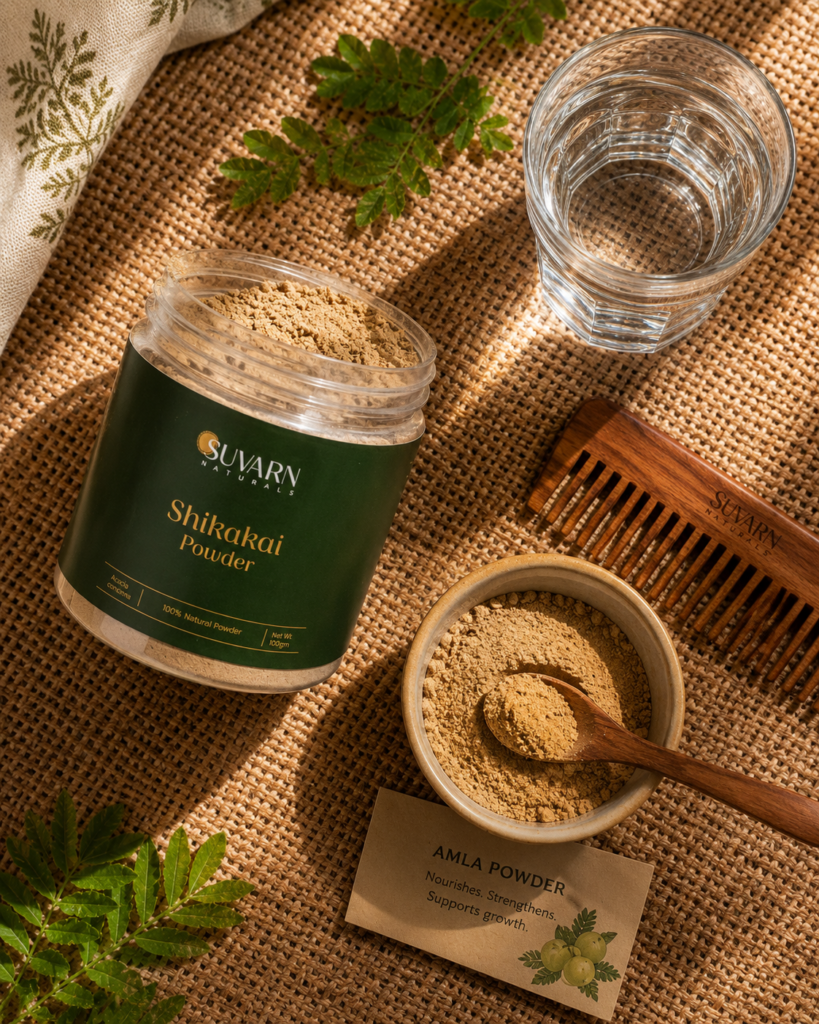
- Mix 2 tbsp Shikakai + 1 tbsp Amla Powder + warm water
- Apply and massage; rinse after 5 minutes
- Ideal for women with hair fall or dull hair
Dos and Don’ts
| Do | Don’t |
|---|---|
| Use warm (not hot) water for mixing | Use boiling water — it may degrade saponins |
| Rinse thoroughly to remove all powder | Leave any paste residue in hair — it may cause dryness |
| Combine with Amla for hair fall support | Use daily on very dry or chemically treated hair |
| Patch-test on wrist before first full use | Expect strong lather — low foam is normal |
| Be consistent for 8–12 weeks | Expect visible results in under 2 weeks |
The 3-Minute Shikakai Ritual Before Every Wash
This is the section most hair care blogs skip — and it is where results actually compound.
Think of this as a scalp-prep ritual, not just a wash. Done consistently, it takes 3 minutes and dramatically improves how well Shikakai works.
Ingredients
- 2 tbsp Suvarn Naturals Shikakai Powder
- 1 tbsp Suvarn Naturals Amla Powder (optional but powerful)
- ½ cup warm water
- 4–5 drops of any lightweight hair oil (coconut, brahmi, or castor)
Steps
- Prep (1 minute): Combine Shikakai, Amla, and warm water in a small bowl. Stir gently into a paste. Let it sit for 2 minutes to activate the saponins.
- Scalp oil (30 seconds): Apply 4–5 drops of oil directly onto dry scalp sections. Massage in circular motions for 30 seconds. This pre-oil protects the scalp’s moisture barrier.
- Apply paste (1 minute): Section your hair. Apply Shikakai paste with fingertips directly to the scalp. Work through gently — no harsh rubbing.
- Wait: Let it sit for 3–5 minutes. Breathe. This is your ritual, not a task.
- Rinse: Use cool water. Work through the lengths gently. Ensure no gritty residue remains at roots or hairline.
Pro tip: Mix your Shikakai paste with our Amla Powder — Amla’s natural vitamin C and tannins work alongside Shikakai’s saponins to address both scalp health and strand strength in a single wash. This is the closest modern equivalent to the traditional chawl (traditional paste) grandmothers across India used before synthetic shampoos existed.
Shikakai vs Shampoo vs Alternatives — Full Comparison
| Feature | Suvarn Naturals Shikakai Powder | Generic Shikakai Powder | Shikakai-Based Shampoo Bottle | Commercial Sulfate Shampoo |
|---|---|---|---|---|
| Ease of use | Medium — paste prep needed | Medium | Easy | Very easy |
| Time to visible results | 6–12 weeks | 6–12 weeks | 4–8 weeks | Immediate cosmetic effect |
| All hair types | Yes | Yes | Mostly | Yes |
| PCOS / hormonal scalp | Highly suitable | Suitable | Moderate | Not ideal |
| Long-term scalp health | High | Moderate | Moderate | Often poor |
| Sulfate / paraben free | ✅ Yes | ✅ Yes | Check label carefully | ❌ Mostly No |
| Approx. cost per wash | ₹5–10 | ₹4–8 | ₹20–40 | ₹15–35 |
| Chemical additives | None | Check sourcing | Often present | Yes — preservatives, fragrance |
Note: “Time to results” refers to sustained improvement in scalp health and hair texture, not cosmetic shine from conditioning agents.
Side Effects and Precautions
Shikakai is considered gentle and well-tolerated by most users. However, it is important to know when caution is needed.
Possible mild reactions:
- Scalp dryness in very low-moisture or bleached hair — especially if used too frequently. Limit to 1–2 times a week and follow with light oil on ends.
- Mild tingling on a sensitive scalp — common in the first 1–2 uses and typically settles.
- Eye irritation if paste enters the eyes — rinse with cool water immediately.
Pregnancy and breastfeeding: Some traditional sources classify Shikakai as a herb with mild uterine-stimulating properties when consumed internally. As a topical hair wash, the risk is considered very low, but it is best to consult your gynaecologist before use during the first trimester, as a precaution.
Allergies: Do a patch test on your inner wrist 24 hours before first full use. If redness, swelling, or persistent itching occurs, discontinue.
Drug interactions: No well-documented interactions with medications for topical use. If you are using prescription scalp treatments (for alopecia areata or psoriasis), check with your dermatologist before switching your cleanser.
When to see a doctor: If you notice sudden, patchy, or rapidly progressing hair loss; scalp lesions; or significant changes in hair texture alongside other health symptoms — these may signal an underlying condition that requires medical evaluation, not just a change in shampoo.
Myths and Mistakes Women Make with Shikakai vs Shampoo
Myth 1: “If It Doesn’t Lather, It Isn’t Cleaning”
This is the most common reason women abandon Shikakai in week one. But foam is a sensory cue, not a functional one. Saponins are effective surfactants that remove dirt, oil, and product residue without generating the theatrical lather SLS produces. Your hair will feel clean after rinsing — often cleaner than it did with shampoo, because the scalp’s natural oils are retained rather than stripped.
Myth 2: “Shikakai Works Immediately”
Unlike a conditioning shampoo with silicones that coat each strand instantly, Shikakai works at the biological level — supporting scalp pH, follicle health, and sebum regulation. Expect 3–6 weeks before you notice consistent improvement. The women who give up in week two miss the inflection point.
Myth 3: “Powder Shikakai Is Only for ‘Natural Hair Types'”
Shikakai suits wavy, straight, curly, and coily hair. It is particularly useful for colour-treated hair that needs gentle cleansing, and for chemically relaxed hair that can’t withstand alkaline shampoos. Low pH = cuticle-friendly = colour retention.
Myth 4: “You Can’t Use Oil Before Washing with Shikakai”
In fact, a pre-wash oil application (oil massage 30–60 minutes before washing) works beautifully with Shikakai. The saponins are effective at emulsifying light oils without stripping hair dry. This is the traditional approach — a quick oil massage, followed by a Shikakai wash.
Myth 5: “Shikakai Is Just for Hair Fall”
Shikakai’s Keshya classification in Ayurveda encompasses all aspects of hair wellbeing — not just growth. It is a complete hair wash system for daily scalp hygiene, shine, softness, and long-term follicle health.
Notes from the Suvarn Naturals Founder
“We explored traditional hair care ingredients because we wanted hair routines to feel simpler and closer to nature. During our early research, we kept coming across ingredients like Shikakai that had been used for generations. Its earthy texture and traditional use inspired us to include ingredients people already knew and trusted.
What struck me most when I first worked with Shikakai powder was the smell — that warm, almost woody, slightly herbaceous scent of the dried pods. It smells nothing like a laboratory. It smells like something that grew.
We source our Shikakai from small-batch, traditionally farmed suppliers. Before any batch reaches you, we check for moisture content, microbial safety, and absence of adulterants. We grind it fine enough to mix easily but coarse enough to retain the full phytochemical profile.
The first time a customer messaged us saying her hairdresser asked what she had changed — because her hair looked healthier — we knew we were on the right path. These are not fast results. But they are real ones.”
— Suvarn Naturals Team
Explore our full range at suvarnnaturals.com
FAQs — Shikakai vs Shampoo
Q1: Can I use Shikakai every day instead of shampoo?
Daily use of Shikakai is generally considered safe, but most hair types do best with 1–2 washes per week. Daily use may cause mild dryness in low-porosity or dry hair. Start with twice a week and observe how your scalp responds over 3–4 weeks before increasing frequency.
Q2: I have dandruff. Will Shikakai help or make it worse?
Shikakai’s natural antifungal compounds may help with mild, sebum-related dandruff. Its low pH also creates a less hospitable environment for Malassezia (the fungus associated with dandruff). Leave the paste on for 3–5 minutes before rinsing to maximise contact time. Severe or flaking scalp conditions should be evaluated by a dermatologist.
Q3: Will Shikakai work for PCOS-related hair fall?
Shikakai may support scalp health and reduce the inflammation that worsens hormonal hair fall. It does not address the hormonal root cause — PCOS requires medical management. However, replacing a harsh sulfate shampoo with Shikakai may help reduce scalp irritation and oil-rebound, which are common complaints in PCOS-related hair loss. For best results, pair it with Amla Powder, which traditionally supports hair strength.
Q4: How long before I see results from using Shikakai instead of shampoo?
Most women notice improved hair texture and reduced scalp oiliness within 3–4 weeks. Visible reduction in hair fall and improved hair density are typically observed at 8–12 weeks of consistent use. The scalp takes 2–3 weeks to recalibrate its oil production after transitioning from sulfate shampoos.
Q5: Can I use Shikakai on chemically treated or colour-treated hair?
Yes — Shikakai’s low, mildly acidic pH makes it gentler on colour-treated hair than most commercial shampoos. Acidic conditions help the cuticle lie flat, which may improve colour retention. Avoid leaving the paste on for more than 10 minutes on very porous or bleached hair.
Q6: What should I mix with Shikakai powder for extra hair growth support?
The most classical Ayurvedic combination is Shikakai + Amla + Reetha (Soapnut). Amla provides vitamin C and tannic acid, which may strengthen follicles and reduce breakage. Suvarn Naturals Amla Powder is a simple addition to your Shikakai paste — use a 2:1 ratio (two parts Shikakai, one part Amla).
Q7: Is Shikakai safe to use during breastfeeding?
Topical use on the scalp during breastfeeding is generally considered low risk, as systemic absorption from a rinse-off product is minimal. However, every individual is different. If you are breastfeeding and cautious, consult your doctor before making the switch.
Q8: Why does my hair feel different (drier or flatter) in the first two weeks?
This is the transition period. Your scalp is accustomed to the rebound oil cycle created by sulfate shampoos. As it recalibrates — typically over 2–3 weeks — oil production normalises. Apply a small amount of light oil to your lengths (not scalp) on non-wash days to manage dryness during this adjustment phase.
Q9: Can men use Shikakai powder too?
Yes — Shikakai suits all hair types and genders. Men with oily scalps or dandruff may find it particularly beneficial. The low pH and antifungal properties address common male scalp concerns without the harsh stripping effect of many men’s shampoos.
Q10: Where can I read more about summer hair problems and natural ingredients?
We’ve covered this in detail in our post: Summer Hair Problems? Natural Ingredients That May Help — a practical guide for managing heat, humidity, and sweat-triggered scalp issues with Ayurvedic ingredients.
Final Takeaway
The shikakai vs shampoo debate isn’t really a debate — it’s a recognition that different tools serve different goals. If you want a scalp that functions well over years, not just hair that looks presentable today, Shikakai is worth your time.
Give it 8 weeks. Mix it with Amla. Let the transition period pass without panic. And notice, quietly, that your scalp starts to feel like it knows what it’s doing again.
When you’re ready to start, Suvarn Naturals Shikakai Powder is exactly what it says it is — nothing added, nothing removed. That simplicity is the point.
Browse all our herbal ingredients at suvarnnaturals.com/shop/.